Introduction
Today, content creators, marketers, and studios are faced with an essential question: Should you invest in traditional VFX or go for AI VFX Generators to meet your VFX requirements? In this guide, we will explore the real differences in time, cost, and quality between these two approaches and provide actionable insights to help you choose the right path for your next project.
What Is Traditional VFX?
The traditional VFX requires specialized artists working with advanced software such as Adobe After Effects. Such software provides unparalleled creative control for tasks ranging from background extensions to fully rendered CGI characters.
But such control requires considerable investment, be it time, personnel, or equipment. Typical VFX pipelines include the following:
- Analysis and Planning
- Asset creation (modeling, texturing, rigging)
- Animation & simulation
- Compositing and rendering
- Revision cycles
- Final delivery
Each stage requires careful review, collaboration, and often, powerful hardware such as render farms and specialist workstations.
Also Read: Trending Caption Styles for 2026: 20+ Viral Caption Ideas
What Are AI VFX Generators?
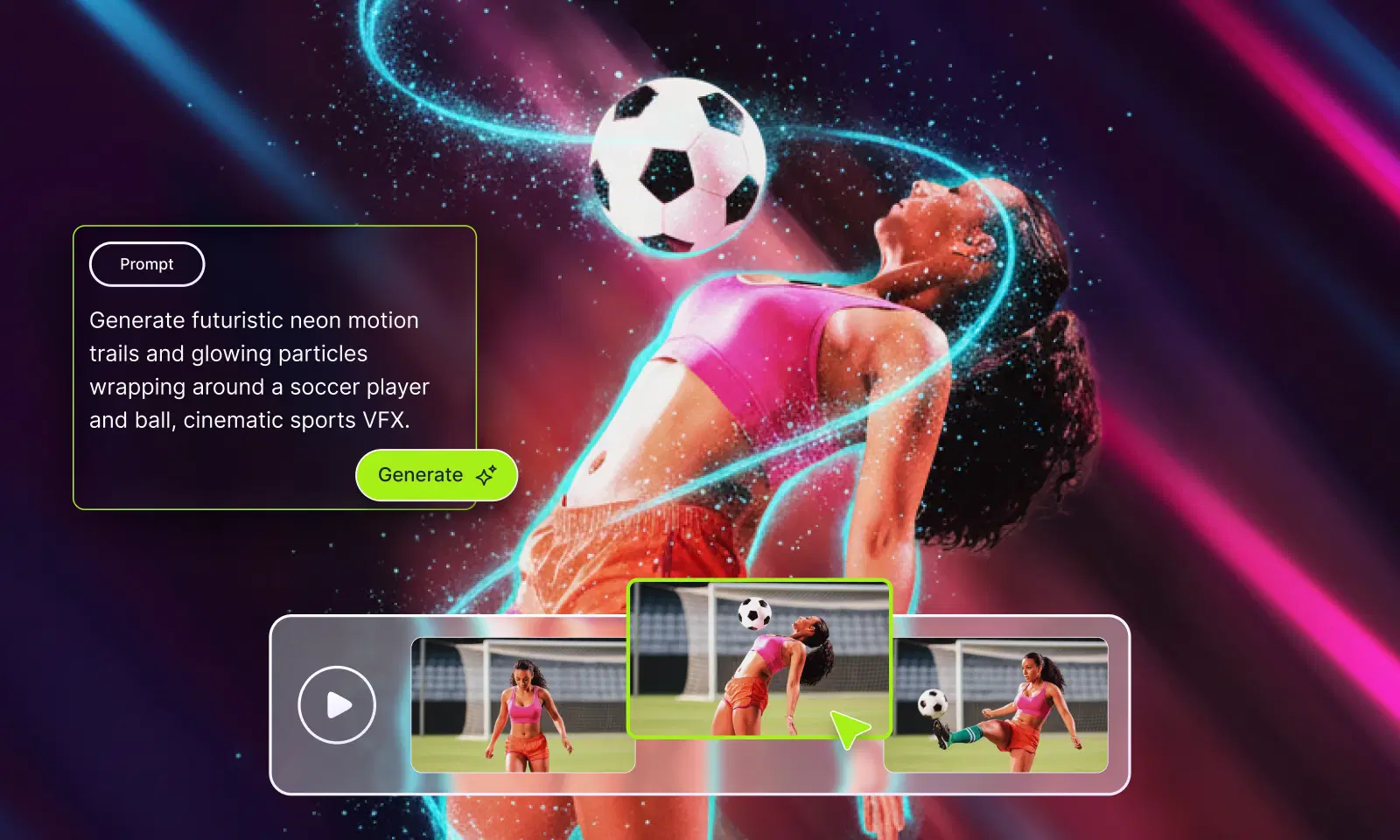
AI VFX Generators are tools that leverage machine learning and computer vision to automate the entire visual effects workflow. Instead of manual rotoscoping and keyframe animation, an AI video editing tool can analyze footage frame by frame and automatically generate effects, like:
- Background removal
- Object isolation and tracking
- Motion effects
- Color grading and scene enhancement
These tools minimize manual effort when completing complex visual tasks.
Time Comparison: Traditional vs AI
Traditional VFX Timeline
Traditional visual effects workflows are fundamentally multi-stage and time-intensive. A typical schedule might look like this:
- Pre-production planning: 1–2 weeks
- Asset creation: 2–4 weeks
- Animation & simulation: 3–5 weeks
- Compositing & final touches: 2–3 weeks
- Rendering per frame for complex shots: Hours to days
- Revision cycles: 2–3 weeks
Total timeline for a VFX-heavy project: 2 to 6 months from concept to final delivery
AI VFX Generator Timeline
AI-powered tools compress this entire process:
- Upload and analysis: Minutes
- AI processing and generation: 10 minutes to 2 hours
- Review and refinement: Hours to 1–2 days
- Export: Minutes to hours
Total timeline for most AI VFX projects: Hours to a few days, not months
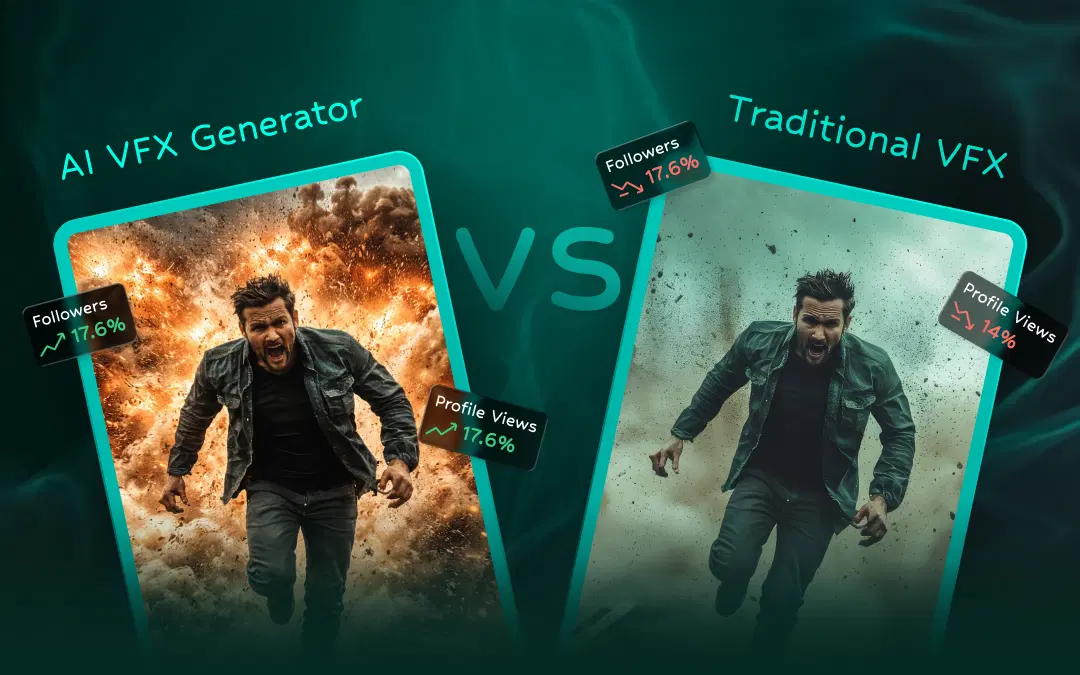
AI VFX generators work 3 to 10 times faster than traditional methods. This allows for quick changes and same-day results. These features are very helpful for social media, fast marketing, and independent filmmaking.
Cost Comparison: Traditional vs AI
Traditional VFX Costs
Traditional VFX projects need high costs across labor, software, hardware, and overhead.
Labor Costs (Estimated)
- Entry-level VFX artists: $50–$100/hour
- Mid-level professionals: $150–$250/hour
- Senior artists & supervisors: $300–$1,500/hour
Project-Based Pricing (Estimated)
- Simple effects: $1,000–$2,000 per finished minute
- Standard projects: $2,000–$5,000 per finished minute
- Complex productions: $20,000–$100,000+ per finished minute
Per-Shot Costs (Estimated)
- Basic VFX shots: $500–$2,000
- Medium complexity: $5,000–$15,000
- High-end cinematic shots: $20,000–$40,000+
Additional Expenses (Estimated)
- Software licenses: $2,000–$10,000
- Hardware & render: $50,000–$500,000+
- Facility overhead: 25–40% markup on labor costs
Also Read: Turn Simple Prompts Into Full Edits
Example:
A 30-second commercial (medium-level) VFX will cost $15,000–$30,000 (estimate) using the traditional method, dependent on complexity and revisions.
AI VFX Generator Costs
AI platforms adopt scalable, software-driven pricing, making professional effects far more accessible.
Monthly Subscription Models (Estimated)
- Basic: ~$29–$49/month; ideal for individual creators
- Professional: ~$99–$199/month; suited for agencies
- Enterprise: Custom pricing; unlimited processing
Unlike traditional VFX, AI systems don't charge per shot or per hour of labor, and there's no need for expensive hardware.
Cost Savings:
AI VFX Generators can cut production costs by 60–90% compared to traditional methods. This is especially true when producing a large number of content.
Quality Comparison: Traditional vs AI
Where Traditional VFX Excels
Traditional VFX is still better for:
- Photorealistic Characters in CGI: Traditional workflows incorporating motion capture and complex detail are still required for digital humans and creatures, as seen in films like Avatar and The Irishman.
- Complex Physics Simulations: There are a few platforms that offer complete control and work well for large-scale destruction, fluid dynamics, and complicated particle effects.
- Custom Creative Vision: Artists with complete creative agency are best suited to create original effects that push the boundaries of visual design.
Where AI VFX Generators Excel
AI-driven tools deliver exceptional outcomes for:
- Automated Tasks: Background removal, object tracking, and automated rotoscoping now match or outperform manual results in many cases.
- Standard VFX Elements: Particle effects, basic compositing, motion graphics, and scene enhancements are produced rapidly and consistently.
- Social Media Content: Short-form video formats (TikTok, Reels, YouTube Shorts) benefit from fast turnaround and platform-optimized outputs from tools like VFX AI Clip Generation.
- Iterative Content Creation: Marketing teams producing multiple variants can iterate more quickly with AI.
- Democratized VFX: Independent creators and small studios now access quality, previously limited to expensive pipelines.
Quality Assessment: For the majority of commercial and digital use cases, AI VFX Generators deliver results that satisfy both audiences and client expectations.
Real-World Use Cases: Which Tool Suits Best
VFX AI tools are well-suited for:
- Content creators and YouTubers who need rapid visual effects for frequent uploads.
- Marketing agencies that produce multiple campaigns.
- Social media managers are optimizing content for specific platforms
- Educators and trainers are enhancing educational videos
- Small business owners creating promotional content
- Podcast creators repurposing into engaging short-form media
In these contexts, VFX AI tools strike a balance between speed, affordability, and quality, empowering creators of all experience levels.
Ideal Projects for Traditional VFX
Traditional methods remain indispensable for:
- Feature films and high-budget productions
- Episodic TV series with large VFX shot counts
- Game cinematics requiring deep integration with engines and artistic direction
Here, traditional workflows justify their premium costs with superior control and detail.
The Hybrid Visual Effects Approach
As both methods have their advantages, current production processes combine both models in a hybrid approach:
- AI handles time-consuming automation (rotoscoping, tracking, cleanup, background removal)
- Traditional teams emphasize more on hero shots and bespoke sequences
- AI speeds up the previsualization and client approval process
This model leverages AI's efficiency without sacrificing the full creative power of traditional VFX.
The Future of Visual Effects
Trends shaping the industry include:
- Real-Time Rendering: Real-time solutions, such as VFX AI, are now enabling faster visual feedback.
- AI-Assisted Traditional Tools: Major software vendors are embedding AI into established pipelines.
- Generative AI Video: Emerging models can create visual effects from text prompts alone.
- Accessibility: Cloud-based VFX tools make advanced effects available to anyone with an internet connection.
- Quality Convergence: AI-generated effects are rapidly catching up to traditional pipelines in many use cases.
The debate between AI VFX Generators and traditional VFX isn't about superiority; it's about fit.
Traditional methods still rule when maximum fidelity and creative nuance are required. But for most digital content today, brand videos, social media, marketing campaigns, and creator content, AI VFX Generators offer the right balance of speed, cost, and visual quality.
The most successful creators in 2026 and beyond will be those who recognise both paradigms and apply each where it makes the most sense.
Are you prepared to learn more about VFX AI? You can create professional-level visuals without the hassle and expense of traditional production pipelines, thanks to platforms like vfxai.com.