Introduction
But here's the reality check for 2026: While video editing is a significant aspect of video content creation, it is not the only thing. In fact, it’s far from it. The reality is that today’s content creators, YouTubers, and social media marketers are drowning in the process of generating ideas, creating content, repurposing it for different platforms, and finally publishing it.
Text-based video editing tools are great, but they’re really just a band-aid for yesterday’s problem. Today’s problem requires a full AI video workflow to run automatically.
The Rise of Text-Based Video Editing
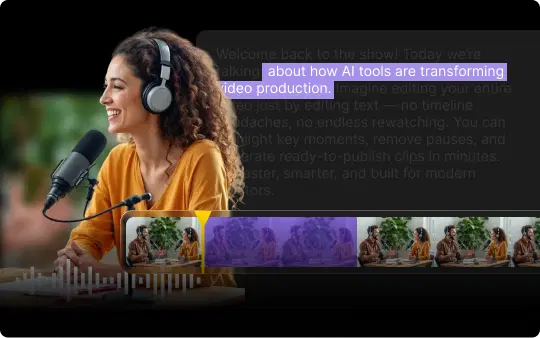
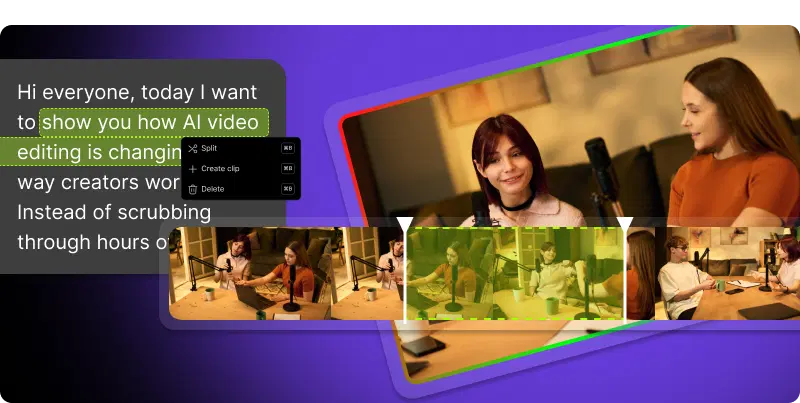
This text-based video editing technology was a game-changer for AI video editing tools, allowing video cuts to be synced with spoken words in a transcript. This meant that if you wanted to cut a sentence, that sentence would disappear, offering drag-and-drop accuracy without needing to know Adobe Premiere or Final Cut Pro
This technology greatly simplified video editing, allowing users to search through a transcript instead of scouring through a video timeline for "that one moment." This technology was a democratizing force for AI video editors, allowing YouTubers to create professional content without needing pro video editing skills.
This technology also helped AI content-creation tools gain widespread popularity, allowing social media marketers to easily edit out filler words or pauses and create videos.
Why Text-Based Editing Alone Is No Longer Enough
Today's content creators are under immense pressure to be present on YouTube, TikTok, Instagram Reels, and LinkedIn, each with its own requirements and expectations. In this environment, text-based video editing is no longer enough. It solves one problem but leaves you to handle the rest of a very long, manual process.
This is why text-based video editing is no longer enough:
Fragmented and Time-Consuming Workflows: The reality is that you are still left to figure out where to add your B-roll, create your own graphics, mix your audio, format your own captions, etc., even if you are using a text-based AI video editing content creation tool.
Lack of Content Ideation: These AI tools do not offer content ideation, arguably the hardest part of content creation. This means you are left on your own every single time you need to create content, doing your own research and coming up with your own ideas.
Manual Repurposing for Multiple Platforms: Your 16:9 YouTube video won't work as a 9:16 TikTok. A text-based editor won't magically turn long-form video into short-form video or vice versa. Exporting content and then editing each video individually is a tedious, soul-sucking process.
Lack of Distribution Automation: Once you've got your videos and clips ready, you're on your own. You've got to write posts, add tags, and schedule them for each platform individually. There's no built-in system for this.
Difficulty Scaling Content Output: These processes are limiting your ability to create content quickly. You can't physically create and distribute more content without hiring a team or burning out. This is a major barrier to using AI video tools for social media growth.
The core issue is clear: Creators don't just need an editor. They need an end-to-end production system.
Also Read: AI Video Editing Software: Create, Edit, and Repurpose Videos Automatically
The New Era of AI Video Workflows
The next generation is here: a shift from single-feature AI content-creation tools to fully integrated AI video workflow platforms. Imagine an AI video production assistant that’s by your side at every stage, from the first spark of an idea to the final click of publish.
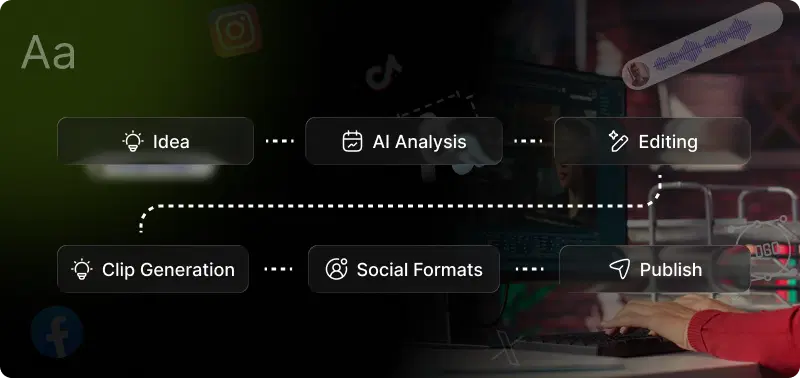
This is the promise of an AI-powered pipeline. It's a system designed to automate video content creation by handling the entire process:
Content Ideation: AI analyzes the latest trends and your channel data to suggest video ideas and hooks that your audience will want to watch and engage with.
Intelligent Editing: The AI does more than just transcribe your video. It analyzes the content, picks out the most exciting, most quotable moments, and the most valuable takeaways, presenting you with ready-to-use clips.
Automated Repurposing: With one click, your long-form video is converted into a library of short-form content, automatically formatted and captioned for TikTok, Reels, Shorts, and all the other social platforms. This is the ultimate in AI clip maker.
Seamless Publishing: The platform integrates with your social accounts, letting you plan and publish all your content from a single place.
This isn’t about replacing the creator. It’s about helping them shine. By automating the bulk of the tedious, time-consuming tasks, these platforms let you focus on your unique creativity and expertise.
The Modern AI Video Pipeline
The best creators today aren’t just using editing tools; they’re creating full-fledged pipelines for their content. Here’s a breakdown of what a modern video creation pipeline for creators might look like, driven by the capabilities of AI technology:
- Ideation
- What are the most popular video ideas in your niche?
- What are the most popular video hooks for increased engagement?
- What are the most popular ideas that creators' audiences are asking for?
- Editing
- What are the most compelling parts of the video that deserve extra attention?
- Which parts of the video can be automatically removed to increase efficiency?
- What pacing does the video need for maximum engagement?
- What kinds of editing can be done for increased audience retention?
- Repurposing
- 8-12 short-form clips with viral potential
- What is the best aspect ratio for each platform?
- What kinds of captions and text overlays are most popular?
- What kinds of thumbnails will be most popular for each clip?
- Publishing
- Automatic upload to connected platforms
- Scheduled posting for optimal engagement times
- Platform-specific caption and hashtag optimization
- Performance tracking across all channels
Before a creator starts rolling the camera, AI has already contributed ideas:
The ideation stage removes the guesswork from “what should I create next?”
The editing stage is where creators work hand-in-hand with AI technology
The editing stage is where creators work hand-in-hand with AI technology
This is where AI video repurposing transforms productivity. A single 30-minute video becomes:
A creator records a single video; AI technology then creates a series of clips from it.
This is where AI video repurposing transforms productivity. A single 30-minute video becomes:
The publishing stage is no longer just editing; it's a full-fledged social media publishing platform.
Also Check: VFX AI Social Media Publisher
How AI Video Repurposing Is Changing Content Distribution
The math behind video repurposing for social media is compelling. Consider the possibilities:
Podcasts: A 60-minute podcast is full of quotable moments, stories, and insights. AI can help identify the most engaging parts of the podcast to create new 15- to 30-second podcast clips optimized for short-form platforms.
Webinars: That 90-minute webinar your team created is full of teachable moments that can be repurposed for LinkedIn and YouTube Shorts. Video conversion tools like VFX AI can help extract the best parts of a webinar to create new webinar clips.
YouTube Videos: Long-form videos on YouTube are a gold mine for creating Shorts. The algorithm-friendly moments that worked in your main video will likely perform as standalone Shorts with the YouTube clip maker.
Interviews: Guest interviews with experts are full of different opinions and sound bites. AI tools for short-form videos can help identify the parts of the interview where the guest has a particularly insightful or provocative comment.
The result? Take a long video and create a library of short videos from it. Suddenly, one piece of content becomes a month's worth of social media posts.
How VFX AI Powers the Full Video Workflow
VFX AI, as a video editing tool, offers a unique style of video editing. Unlike other text-based video editing tools, VFX AI allows the whole workflow:
- AI-native Editing: Not just transcripts, the AI system reads context too. It finds the interesting bits, the best cuts, and the right pace to keep the audience engaged.
- Automatic Clip Generation: Need a bunch of short-form clips from a single video? VFX AI got you covered. The VFX AI clipping tool identifies the most promising shots without requiring you to spend hours scrubbing the video.
- Smart Highlight Detection: The AI system analyzes how people engage with content and its structure to identify the highest-performing shorts.
- Social Media Optimization: The AI system optimizes content for social media platforms based on their requirements.
- Content Repurposing Workflows: The complete pipeline: Ideation → Edit → Repurpose → Publish, in one system designed for creators and teams.
This is AI-driven editing automation, designed for how creators work in 2026.
Benefits of Full AI Video Pipelines
Accelerated Content Production: Cut production times by as much as 90% and get your content published faster than ever before.
Consistent Social Posting: End creator burnout and feed the social media algorithm with high-quality content.
Exponential Content Strategies: Create 10x more content without proportionally increasing your efforts or team size. That’s how you get real social media growth.
Broader Audience Engagement: Reach new audiences across all platforms by making your content more valuable than ever.
Increased Creator Productivity: Let AI handle mundane tasks so you can focus on what matters most: creating. That’s your unique advantage.
Conclusion
Text-based video editing was a major milestone. Nevertheless, the pace at which we generate content today requires more than just a single-feature solution.
The future lies in full AI video workflows that include ideation, editing, repurposing, and publishing. The creators who adopt this new technology will be able to generate more content, grow faster, and be more efficient by spending less time on tasks that do not require human creativity.
Take your podcasts and turn them into a library of content. Turn your webinars into LinkedIn authorities. Turn your YouTube content into Instagram Reels that drive actual business results. Stop hoping for virality. Start building your content engine.