Introduction
It sounds like something only found in sci-fi novels and movies, but it is the reality powering the platforms you use daily. For example, when automatic subtitles appear from Instagram to Netflix, knowing exactly which thumbnail will make you click, AI video analysis is transforming how content is created, distributed, and consumed.
This blog aims to help you learn about different AI concepts related to video analysis. Here, you can find answers on object detection, scene recognition, speech detection in video, and other AI-related terms. Whether you are a content creator, video editor, or simply curious about the technology shaping digital media, understanding these concepts will change how you think about video forever.
What Does It Mean for AI to Understand Video Content?
The video content analysis uses artificial intelligence to extract meaningful insights from video data. While people understand video in its natural flow, AI treats video as multiple layers that work together.
Consider a video as a layered cake:
- The visual layer consists of individual images presented one after another.
- The audio layer encompasses speech, music, sound effects, and ambient noise.
- The contextual layer captures the interaction between visual and audio components over time.
- Finally, there is the metadata layer containing technical details about the video file itself.
When AI analyzes videos, it first considers each layer separately on their own and then integrates the findings into a cohesive story. And this ability to break down videos into smaller parts and to comprehend interactions among them is what makes video content recognition so powerful.
For instance, AI does not just see a person talking. It recognizes the person's face, transcribes their words, identifies the setting (kitchen, office, outdoors), and understands how these elements relate to each other throughout the video.
How Does AI Analyze Video Content?
Have you ever been curious about how AI analyzes videos? Well, here's the answer – AI analyzes content by separating it into four main parts:
Frame-by-Frame Visual Analysis
When AI perceives a video, it sees individual pictures that move fast enough to be recognized as video. Video AI usually processes 24-60 still images per second, and each one is analyzed for the presence of shapes, colors, and other objects, their location and interaction.
Audio Processing
The audio track is separated and processed using specialized algorithms that detect speech, music, and environmental sounds. This analysis is completely independent from visual recognition, but it gets used together with visual information later.
Pattern Recognition
AI also searches for repetitions across various frames, both visual and auditory ones. Patterns include movement, sound, and image repetition.
Temporal Understanding
Above all, AI recognizes that video is a product of time. It tracks how elements change from one moment to the next, enabling it to understand actions, transitions, and narrative flow.
All four aspects are processed simultaneously in modern video AI technologies, giving a complete understanding of any video content in a matter of seconds.
How Does AI Detect Objects in Videos?
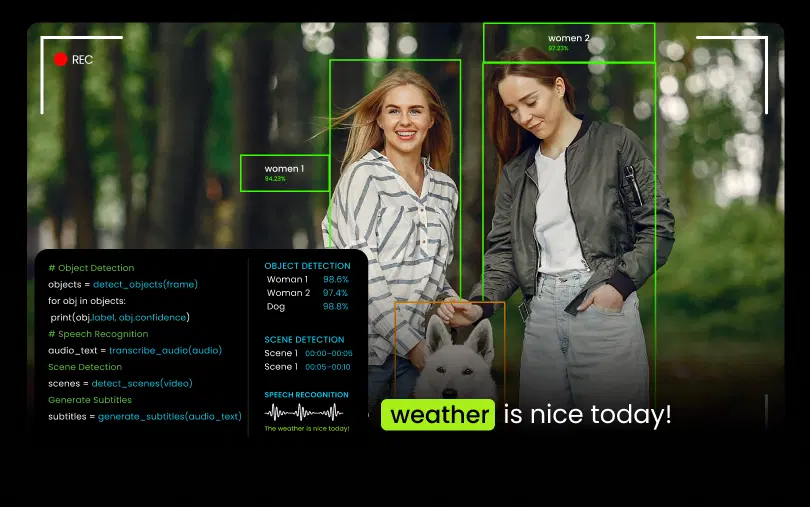
If you are curious about how AI can recognize objects in videos, it can be achieved through the use of special AI algorithms, object detection models, essentially specialized AI systems trained to identify and locate specific items.
Here's the process:
Object Detection in Action
One of the most popular object detection models is YOLO (You Only Look Once). It evaluates every video frame and draws bounding boxes (rectangles) that mark objects within each frame.
Instead of scanning an image multiple times, YOLO performs all of this simultaneously, making the process fast enough to run on real-life video footage. This is why AI-powered platforms can analyze millions of videos daily.
Multi-feature selective attention models enable AI to detect important information in a scene, focusing on objects or people rather than other elements. For example, recognizing that someone is throwing a ball rather than just seeing arm movement.
Real-World Applications
Face detection: Identifying and tracking faces across video frames for content moderation, advertising, or accessibility.
Product detection: Used by e-commerce platforms to identify branded products within videos to facilitate visual search and advertising.
Activity recognition: Understanding specific actions such as dancing, eating, or jogging.
How Does AI Recognize Speech in Videos?
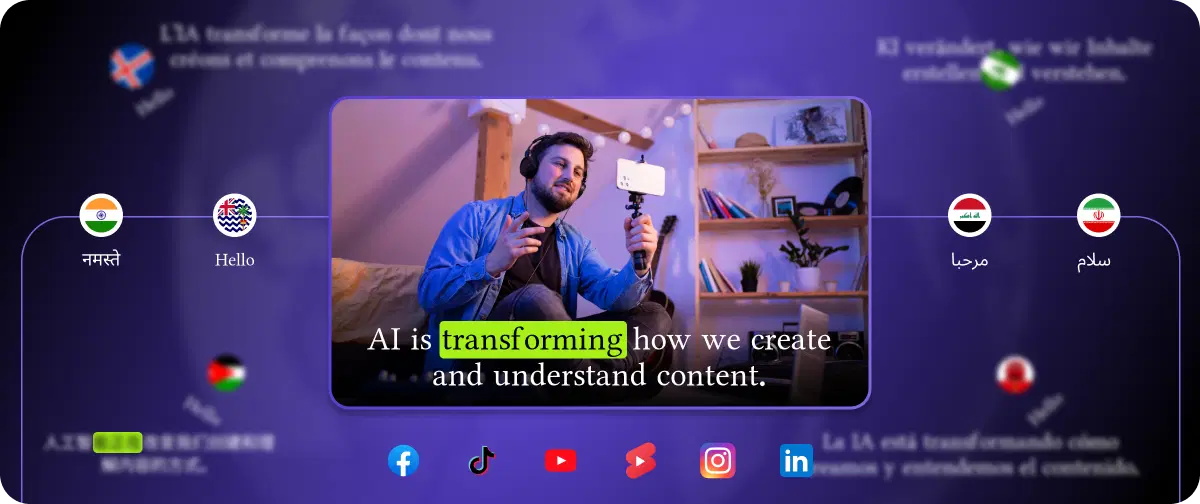
Speech recognition in video content has achieved unprecedented accuracy, enabling features such as automatic subtitles and voice-based search. Here is how AI detects speech in videos.
Speech to Text Conversion
An AI tool converts spoken language into text using automatic speech recognition (ASR). The algorithm analyzes the waveform of speech sounds, recognizes phonemes, and then matches them to language models to produce accurate transcriptions.
The Caption Generation Process
If you ever had to know how AI creates captions for videos, here is the procedure involved:
- Audio extraction from video content
- Speech detection (separation of speech from other sounds like music)
- Speaker detection (identification of who is speaking)
- Speech-to-text recognition
- Timestamp synchronization with video frames
- Correction of grammar and punctuation errors
Multiple Languages Support
The current speech recognition tools can recognize several dozen languages and switch between them during video analysis. That helps build features for automatic video translation on global platforms.
The subtitles that appear in YouTube videos or Instagram Reels are produced using this very technique, making video content accessible to viewers worldwide and searchable by platforms.
How Does AI Detect Scenes in Videos?
Scene detection refers to how AI recognizes when one scene ends and another begins, a crucial capability for comprehending video structure and plot.
Scene Segmentation Explained
Scenes are described as a series of shots that convey a single event or activity. AI detects scene changes based on:
- Visual transitions: Cuts, fades, or dissolves from one shot to another
- Context transitions: Differences in setting, characters, or storyline
- Audio transitions: Transitions in background music or sounds
- Temporal relationships: Understanding that events occur in order
This differs from shot detection (recognition of each camera shot). The former necessitates narrative comprehension because the AI must recognize that the scene is continuous even if the camera and background music have changed slightly, assuming the narrative hasn't altered.
Why Scene Detection is Important for Platforms
The following capabilities rely on scene segmentation:
- Automatic creation of video chapters on YouTube
- Generation of highlight reels for social networks
- Video search using content information
- Adaptive video summarization
- Intelligent video editing suggestions
Also Check: Clean Up Speech
Real-World Applications of AI Video Understanding
Understanding how AI is used in video editing and content management reveals the practical impact of these technologies.
Automatic Caption Creation
The use of AI technology to create automatic captions makes videos accessible to people who cannot hear well or at all, helps with search engine optimization (SEO), and allows users to watch videos without audio.
Content Moderation
Social media platforms use AI in their content moderation tools, which scan uploaded videos to check whether they violate the platform's policies or contain inappropriate content.
Recommendation Systems
AI technology is used to analyze videos and determine their content. Videos are then recommended to users who would enjoy them, such as through the "recommended for you" feature on streaming services.
Video Search
AI understands what happens in a video and allows the user to search for information in it using text, such as "cooking pasta" and find relevant moments within videos, not just matching titles.
Editing Automation
AI technology is used in video editing software to analyze videos, automatically create edits, and recommend changes.
How Platforms Use AI to Understand Videos
Every leading video platform uses AI video understanding to gain an edge in its industry:
YouTube: Object detection is used for visual search, "search by image," while scene detection helps create automatic chapters. Speech recognition transcribes videos to create auto-captions, and semantic analysis suggests related videos.
Netflix & Streaming Platforms: Scene detection helps highlight important scenes to automatically generate previews. Objects and facial recognition help with content categorization and suggestions.
Instagram Reels and TikTok: Real-time object detection helps identify trending objects. Speech recognition creates auto-captions. Scene transitions are analyzed for pacing and rhythm.
LinkedIn Videos: Speech recognition generates transcripts for professional videos, helping boost SEO. Sentiment analysis helps identify engaging scenes.
Benefits of AI Video Analysis for Creators & Brands
AI video analysis delivers tangible advantages for content creators and marketing teams.
Faster Production Workflows
Captioning used to take a long time manually; now AI can do it in seconds. Scene detection can create chapters automatically. Object recognition may be used for automatic tag suggestion. Saving time means getting more content out faster.
Better Audience Targeting
Understanding the actual content of your video, rather than its title and description, allows you to target the right audiences. Your product demo video will be shown to people interested in this particular product type, regardless of whether or not they would look for it.
SEO/Discoverability
Modern search engines understand what's being depicted in a video on a semantic level; your cooking pasta video can become accessible without mentioning the phrase "cooking pasta" in the title.
Large-Scale Repurposing of Content
Identifying the best video content (by detecting actions, changes in scenery, and sentiment) enables the creation of clips and their repackaging into different formats (social media, highlight reels).
Performance Metrics
Knowing what your video contains helps analyze metrics, e.g., "The audience engages most during person X appearing in the video," or "Action scenes have three times more views than any other scenes."
The Future of AI in Video Content Understanding
AI video understanding continues advancing rapidly, with several developments on the horizon.
Live Processing
Processing video content as it is recorded, enabling live feedback and instant optimization during production.
Personalized Videos
AI that tailors video content to viewers' tastes, generating customized versions of the same content.
Assisted Video Edits
An intelligent AI system that understands what needs to be done with a piece of video content and executes accordingly, using natural language instructions.
Sophisticated Video Management
AI video comprehension is advanced enough to enable conversation-based search, accurate content matching, and video content management.
The development of AI video analysis has revolutionized the process of creating, distributing, and consuming video content. Technologies such as object detection and speech recognition run tirelessly behind the scenes of each application you have ever used.
Knowledge of AI perception of video content is mandatory for anyone involved in creating video content. If you do not know about it, you lose the opportunity to make the best out of your video content.
The advancement of AI technologies will inevitably create a chasm between those who can utilize these opportunities and those who choose to ignore them. The question is not whether AI will change the way we perceive videos; it already has. The question is whether you will use that transformation to your advantage.
Tools such as VFX AI leverage these technological advancements to provide video content creators with an easy-to-use platform for creating intelligent video content.